 Weather data provided by OpenWeather

Bank of Ghana (BoG) Governor Dr Johnson Pandit Asiama has announced that interest rates on short-term instruments moderated, with yields on the 91-day Treasury bill rate declining to 4.6 percent in October 2026, from 10.6 percent in October 2025.
Also, he said banks’ average lending rate eased to 15.8 percent from 22.2 percent over the same comparative period.
The low interest rate environment improved credit conditions and increased demand for credit, contributing to a significant expansion in bank lending, Dr Asiama said.
Accordingly, he added, growth in credit to the private sector increased to 37.2 percent from 13.9 percent.
In real terms, he said, private sector credit grew by 30.0 percent, compared with 5.4 percent over the same period. Provisional data on the government budget execution for the first ten months of 2026 showed an overall fiscal deficit, on commitment basis, of 1.0 percent of GDP, against the target of 3.0 percent of GDP. The deficit was financed largely from domestic sources, he said.
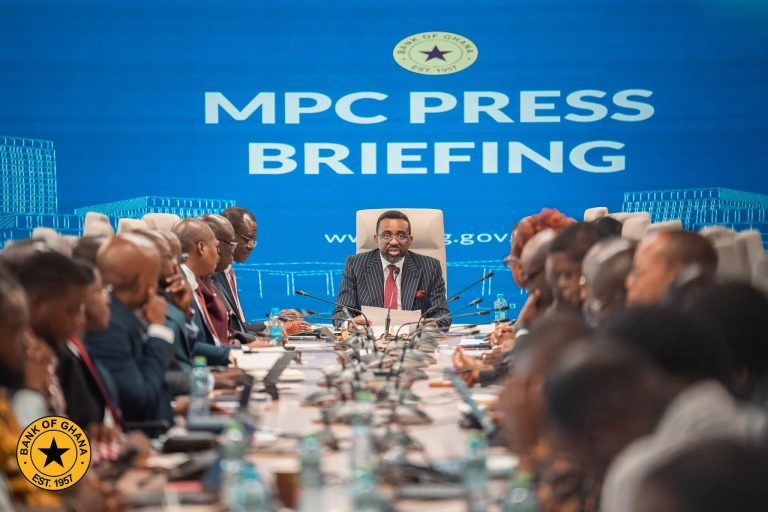
Dr Asiama was speaking during the 133rd Monetary Policy Committee (MPC) press conference in Accra last Wednesday.
Regarding the primary balance, he said, on commitment basis, it recorded a surplus of 1.4 percent of GDP and on track to achieve the full year target of 1.5 percent of GDP due to the combined effects of fiscal prudence and effective public debt management. As of end-October 2026, the provisional public debt stock was GH¢759.3 billion, equivalent to 47.5 percent of GDP, up from GH¢641.1 billion, equivalent to 44.7 percent of GDP, at end-December 2025.
He also said the banking sector remains solvent, profitable, and liquid. As at end-October 2026, banks’ total assets rose by 21.2 percent year-on-year to GH¢512.9 billion, driven mainly by strong deposit growth. The financial soundness indicators also improved broadly.
“Capital Adequacy Ratio rose to 18.5 percent in October 2026, from 17.9 percent a year earlier. Asset quality also improved markedly, with the Non-Performing Loan (NPL) ratio declining to 13.1 percent from 19.5 percent over the same period the previous year, supported by the strong rebound in credit and a contraction in the stock of NPLs. The external sector was resilient during the first ten months of 2026, despite heightened global uncertainty and geopolitical tensions.
“The trade surplus improved substantially to US$13.0 billion between January and October, up from US$8.7 billion over the same period in 2025. Gold was the main driver of export growth, accounting for approximately 67.0 percent of total export earnings during the period. Higher external payment obligations, driven largely by geopolitical tensions and foreign exchange demand pressures, weighed on the central bank’s reserves.
“As at 17 November 2026, Gross International Reserves (GIR) stood at US$12.1 billion, approximately 4.4 months of import cover, down from US$13.8 billion, equivalent to 5.7 months of import cover at end-December 2025. The external sector is expected to remain firm, supported by strong export receipts despite the likely volatility in global markets,” he said.